Continuity
Keep the same match and its relationships throughout the journey.
Product conception · Interface design · Development
A connected digital home for Cameroonian football.
What if interest in the Lions became an entry point into all of Cameroonian football? I explored that idea through a navigable product, a shared visual identity and a film campaign built from its real interface.
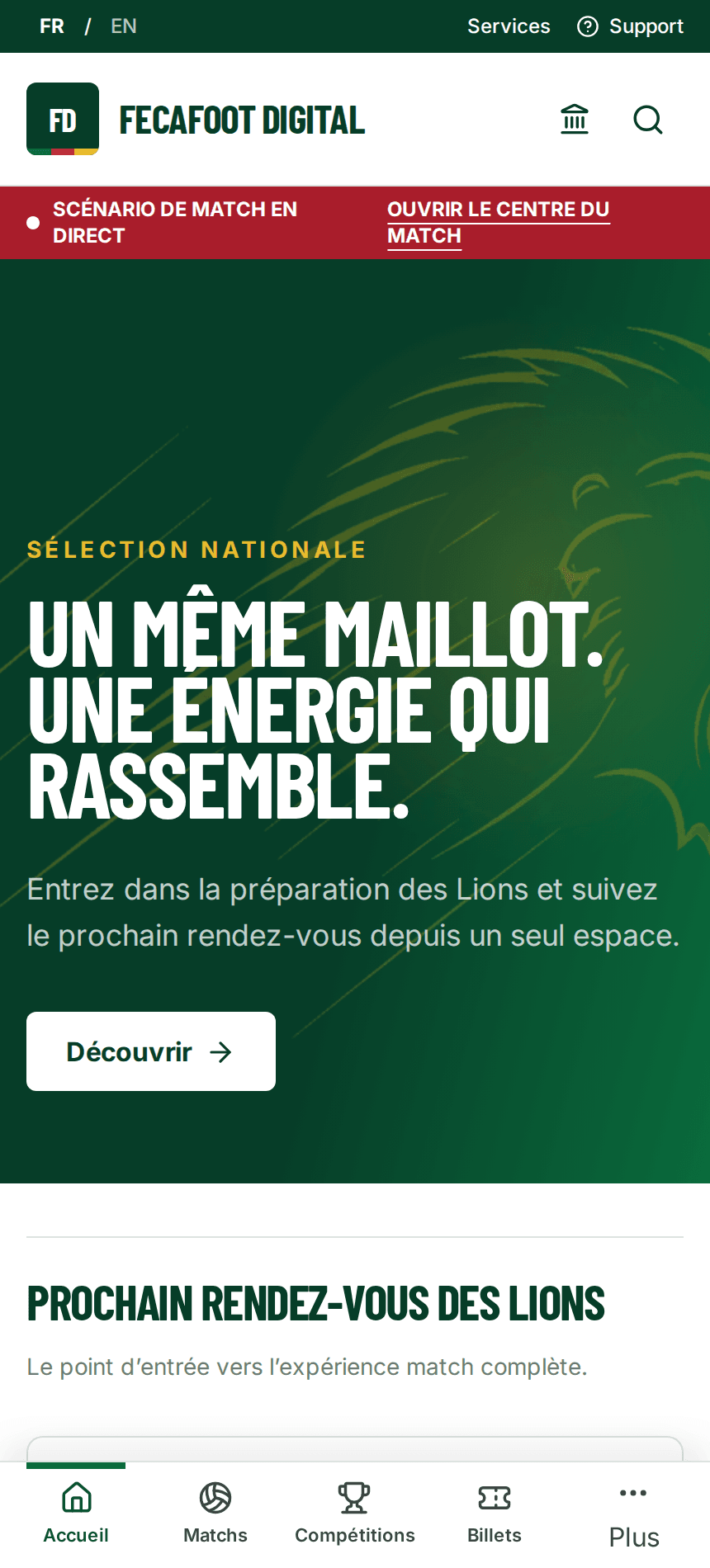
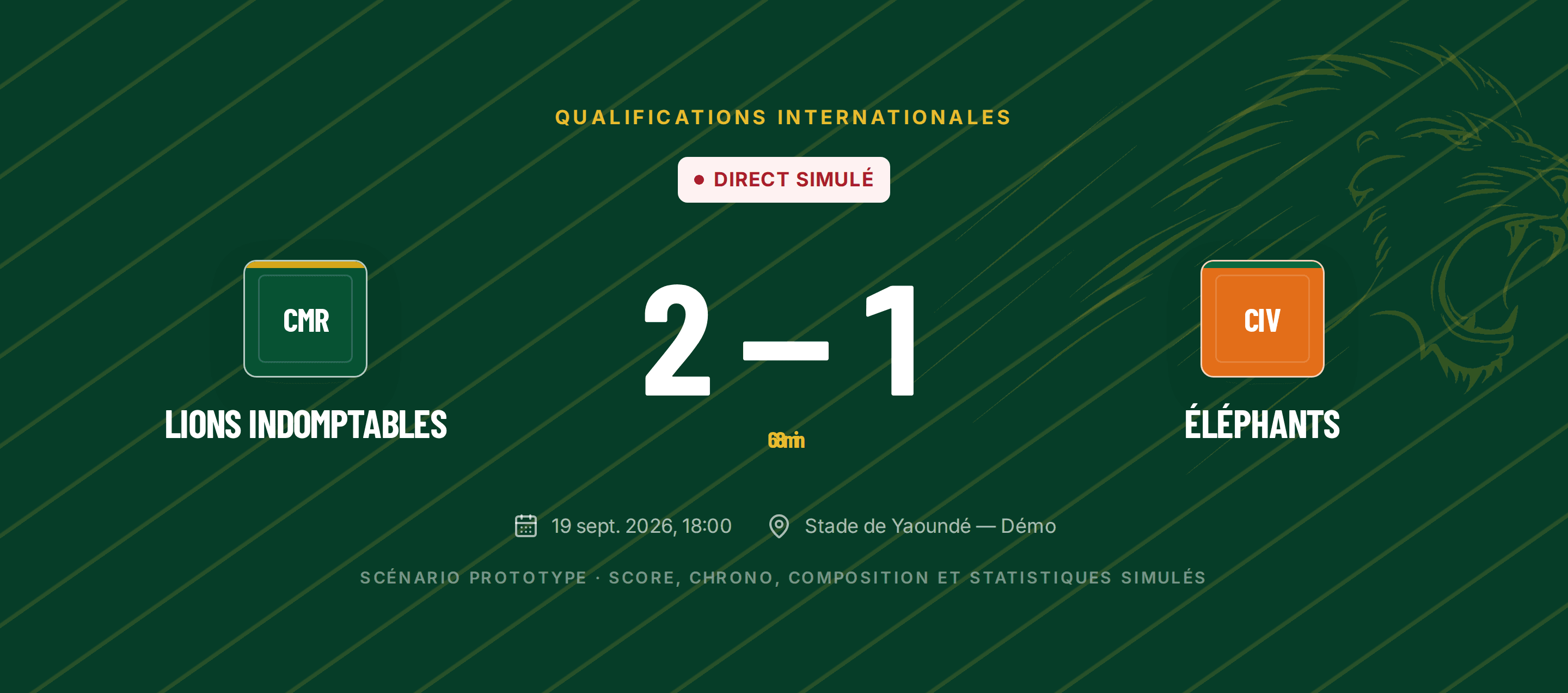
FECAFOOT Digital — System overview
The national team is a natural starting point. My idea was to extend that interest: discover a player, find their club, explore their league and follow their next match.
I organized the product around these relationships. Men’s and women’s teams, domestic competitions, media and football heritage share a connected experience.
The Match Center preserves the identity of the same fixture as it moves through preparation, simulated live coverage, the result and the aftermath. Lineups, events and related content sit around that shared object.
From there, supporters can explore simulated ticketing, broadcast information and player profiles, then find their follows and reminders in My FECAFOOT.
I developed a green, red and yellow visual direction, expressive typography and reusable components across the product’s different surfaces.
Mobile navigation, club pages, profiles and competition spaces use familiar patterns. French and English are part of the core journeys.
The prototype uses Next.js, TypeScript and shared football data. Matches, players, clubs and competitions connect to one another so visitors can follow a continuous journey.
Browser-specific demonstration state retains preferences, reminders and simulated tickets. Playwright scenarios cover the continuity between supporter actions and their personal space.
I extended the work into a film series: a teaser to establish the idea, a reveal to show the whole experience, then focused stories around the Match Center and ticketing.
The pipeline combines Playwright captures of the real interface with Remotion compositions. Each film has its own rhythm: tension and convergence for the teaser, chapters for the reveal, and time passing around one fixture for the Match Center.
The longer-term vision is to build a structured memory of Cameroonian football and inform decisions about content, competitions and supporter relationships. That ambition would require reliable data, governance and real measurement; the prototype makes no claim to have delivered those outcomes.
FECAFOOT Digital is a personal, independent initiative with no claimed official affiliation with the federation. It illustrates a product vision; the fixtures, accounts, tickets and metrics are simulated.
The result is an explorable experience that makes the proposed connections tangible. Payments, video streaming, production authentication and real audience measurement remain outside its scope.
+ Engineering principles
Keep the same match and its relationships throughout the journey.
Connect national attention to domestic clubs and competitions.
Share an identity and components across football experiences.
Make the independent status and simulated interactions visible.